By José Graziano da Silva, Former Director-General of FAO | 22/04/2025
The passing of Pope Francis marks the end of a leadership that profoundly influenced international debates on social justice, poverty, climate change, and food security. Since the beginning of his papacy in 2013, he adopted a clear and consistent stance on the structural challenges affecting the most vulnerable populations, with a particular emphasis on hunger and social exclusion.
I had the honor of accompanying Pope Francis during much of his pontificate, while serving as Director-General of the Food and Agriculture Organization of the United Nations (FAO) from 2013 to 2019. Few have understood, as he did, that hunger is a wound caused both by injustice and neglect. Pope Francis also viewed hunger as one of the structural causes of forced displacement. “Where there is no bread, walls arise,” he would say.
In 2014, during his first visit to FAO headquarters on the occasion of the Second International Conference on Nutrition (ICN2), Francis warned of the fragmentation of food policies and urged world leaders to renew their commitment to the human right to adequate food. His address highlighted the responsibility of governments to ensure fair and sustainable food systems and to combat all forms of food waste and inequality in access to food.
Throughout his papacy, Francis consistently defended family farming as a cornerstone of global food security, with small-scale producers as its true guardians. For him, family farmers represented not only a mode of food production but a way of life rooted in balanced relationships with the land, sustainable natural resource management, and the transmission of traditional knowledge. In his words, “the future of food lies in peasant farming, in agroecology, in family- and community-based models that care for both the Earth and its people.”
This vision resonated with the growing relevance of agroecology on the global stage, as a response to the environmental limits of the industrial agricultural model. The Pope recognized that transitioning to more sustainable systems required not only technological innovation, but a paradigm shift—one that placed human dignity at the center of economic decisions.
The encyclical Laudato Si’, published in 2015, consolidated this thinking. In it, Pope Francis introduced the concept of “integral ecology,” proposing a systemic reading of contemporary challenges. Environmental degradation, hunger, rural unemployment, biodiversity loss, and forced migration were, to him, interrelated expressions of a common imbalance. Laudato Si’ became a point of reference not only for the religious world but also for researchers, policymakers, and community leaders around the globe.
Pope Francis also systematically denounced the structural causes of forced migration. For him, hunger, armed conflict, and the lack of economic opportunity lay at the heart of contemporary migratory flows. A symbolic gesture of this commitment was his donation to FAO, in 2017, of a sculpture representing the Syrian boy Aylan Kurdi, who died while crossing the Mediterranean. Installed at the entrance of FAO headquarters in Rome, the piece symbolizes the human cost of a system that fails to guarantee even the bare minimum for a dignified life.
That same year, during his second visit to FAO to mark World Food Day, Pope Francis once again raised the alarm: international commitments were weakening. Solidarity, he said, was in retreat. He emphasized that hunger is not resolved merely with resources but with political will and a renewed sense of shared responsibility.
His relationship with Brazil was also unique. On several occasions, he praised the country’s efforts in combating hunger and promoting inclusive social policies. During the pandemic, he publicly commended agrarian reform families for donating food to communities in vulnerable situations. He saw in Brazilian family farming a concrete example of solidarity.
Francis often criticized food waste, calling it a moral offense against the poor. In a 2019 letter to FAO, he wrote: “The food we throw away is unjustly taken from the hands of those who lack it. It is time to rethink our choices and systems based on equity and collective responsibility.”
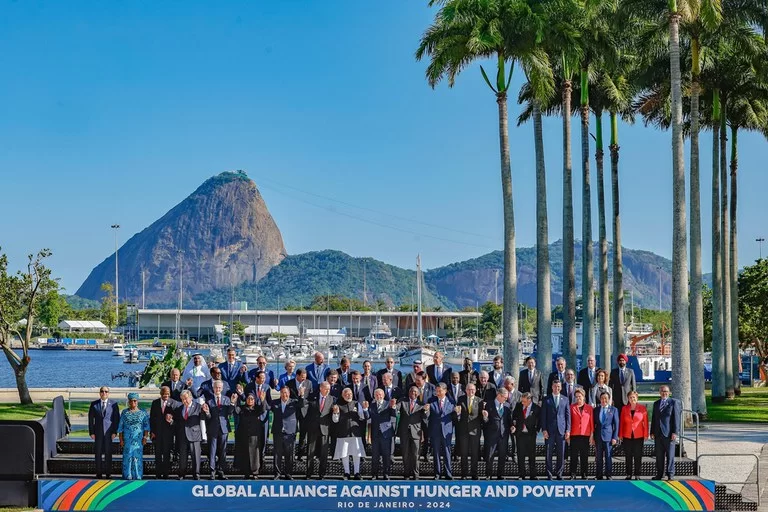
Another recurring point in his addresses was the need to restore the role of multilateral institutions, in response to the growing erosion of multilateralism and the fragmentation of global responses to hunger. In his message to the G20 meeting in Brazil in 2024, Francis called for greater ambition and collective responsibility in the launch of the Global Alliance Against Hunger and Poverty. He urged for the strengthening of social protection systems, support for local food production, and enhanced coordination among countries to effectively address food insecurity. “More must be done. Hunger is a scandal, not a statistic.”
The Pope also recognized the positive impact of national experiences such as Brazil’s anti-hunger policies in the early 2000s. He valued the strengthening of family farming, public food procurement programs, school feeding initiatives, and agrarian reform policies. During the COVID-19 pandemic, he once again commended agrarian reform families for their solidarity actions and donations to vulnerable urban populations.
His statements always sought to translate principles into concrete actions. Francis advocated for public policies that integrated food security, rural development, environmental protection, and economic justice. He criticized the indiscriminate use of pesticides, financial speculation on food, and the concentration of land and markets.
In every meeting I had with him, I was always struck by the clarity of his vision and the tenderness with which he addressed the harshest realities. Francis was both radical in his ethics and humble in his language. He spoke of hunger, migration, injustice, inequality, and climate crisis with the serenity of one who believes—and the courage of one who refuses to conform.
His final message, delivered in his Easter homily on the eve of his death, reaffirmed his commitment: “I appeal to all those in the world with political responsibility: do not yield to the logic of fear that closes off, but use the resources available to help those in need, to fight hunger, and to promote initiatives that foster development. These are the weapons of peace: those that build the future instead of spreading death.”
This phrase encapsulates his legacy: a lasting appeal for political responsibility, international solidarity, and the construction of a world where food, dignity, and peace are universal rights—not privileges.