By José Graziano da Silva, director of Instituto Fome Zero | 07/28/2025
The 2025 edition of The State of Food Security and Nutrition in the World (SOFI) report, released on July 28 in Addis Ababa, officially confirmed what we had been observing over the past two years: Brazil is once again off the FAO Hunger Map. The country’s prevalence of undernourishment (PoU) dropped to 2.4% for the 2022–2024 period, below the 2.5% threshold set by the United Nations.
However, PoU is not the best indicator for determining whether a country is on the Hunger Map. It suffers from a lack of up-to-date data, especially for the coefficient of variation in food distribution, which depends on income distribution data—not always available on an annual basis. That’s why periodic updates to the series are necessary when new information becomes available, as happened this year. Moreover, PoU is a single, national-level aggregate indicator that, in a country like Brazil—marked by deep income disparities among its population and across regions—doesn’t tell us much.
For these and many other reasons, the food insecurity prevalence indicator (FIES) is increasingly used. It’s based on field surveys conducted annually in FAO member countries and is similar to Brazil’s EBIA (Brazilian Food Insecurity Scale).
The most positive finding is that in 2024, the combined prevalence of moderate and severe food insecurity in Brazil fell below 10%, just as it had in 2014 when the country was first removed from the Hunger Map. Severe food insecurity affected only 1% of the population—again, the same as in 2014!
This data not only marks the end of an institutional reconstruction cycle initiated by President Lula’s third term in 2023, but also compels us to look back and reflect on the lessons learned—and those still ignored.
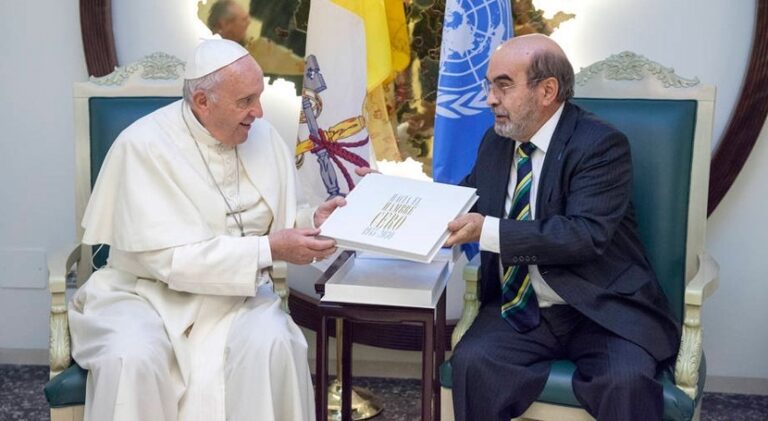
I vividly remember that September (photo), when I personally handed President Dilma Rousseff the official FAO recognition during the UN General Assembly in New York, confirming that Brazil had eradicated hunger according to international standards. The country had achieved, two years early, the Millennium Development Goal (MDG) of halving hunger. It was the peak of a virtuous decade: Fome Zero had become state policy, the Bolsa Família program had solidified as an international model of conditional cash transfers, and the National Food and Nutrition Security Council (CONSEA) had regained its participatory leadership.
But history took a different turn.
Starting in 2016, with the gradual dismantling of social policies—including hunger eradication—a period of regression began, deepened under Bolsonaro’s administration. The 2019 dissolution of CONSEA was more than symbolic: it was a blatant attempt to erase from Brazilian institutions the principle that food is a right—not a privilege. Budget cuts followed for the Food Acquisition Program (PAA), school meals were neglected during the pandemic, and support networks for family farming were torn apart. The result? Brazil was back on the Hunger Map even before the pandemic hit—a tragic setback!
If Brazil is off the Hunger Map today, it is because it resisted. The strong presence of civil society prevented the state policy to fight hunger—enshrined in the Constitution since 2010—from being buried. Networks like ASA (Articulation of the Semi-Arid), PENSSAN, the Parliamentary Fronts Against Hunger, universities, solidarity kitchens organized by social movements, and food bank networks—among many others—kept the flame of good practices and organized solidarity alive.
The election of a new Lula government in 2022 reopened the window of opportunity to rebuild rights-based public policies. CONSEA was restored in early 2023, Bolsa Família was restructured, PAA was relaunched, and the Brazil Without Hunger Plan returned to the heart of the federal government’s strategy. Within just two years, we reversed the upward trend of hunger and exited the Map once again.
But we cannot repeat the 2014 mistake: confusing an arrival point with a final destination.
Being removed from the Hunger Map is a victory—but it’s far from enough. SOFI 2025 data shows that 28 million Brazilians still experience some degree of food insecurity, either moderate (which compromises the quality of diet) or severe (which compromises the regularity of daily meals). On top of that, SOFI 2025 reveals that nearly one-quarter (24%) of the population cannot afford a healthier diet, including fruits and vegetables. This means around 50 million Brazilians lack the financial means to eat healthily, according to FAO estimates.
As a direct consequence, SOFI 2025 shows that 46 million Brazilians were already overweight in 2022. More than 20% of the adult population is obese, and nearly 60% is overweight—a proportion that continues to rise year after year. The same policies that helped reduce hunger have not been able—or lacked political backing—to curb the spread of ultra-processed foods, deceptive marketing, and the monocultural food model imposed by today’s markets.
This neglect by the State—not just a single administration—has serious consequences for our future. Childhood obesity is growing, noncommunicable chronic diseases burden our healthcare system, and the social and economic costs of malnutrition accumulate in the poor learning outcomes of our children, the low productivity of our workers, and greater vulnerability to disease. In 2025, as in 2014, we beat hunger through public policy. But we have yet to tackle the healthy eating agenda in an integrated way!
The good news is: we’ve never been better equipped to do so. The new Global Alliance against Hunger and Poverty, launched with support from Brazil and G20 countries, is based on the principle that a basket of interlinked, intersectoral, and sustainable public policies is needed. If we want to help tackle hunger and malnutrition globally, we must lead by example at home. Healthy eating in Brazil must be treated as a permanent pillar of state policy.
We already know: hunger must not return, and malnutrition can no longer remain invisible. Brazil’s recent history proves that tragic setbacks can be reversed when there is political will and collective action with strong societal participation. Let the recognition we’ve received in SOFI 2025 mark the beginning of a new phase—one that is more ambitious, more just, and more complete—in our fight against hunger and all forms of malnutrition.